

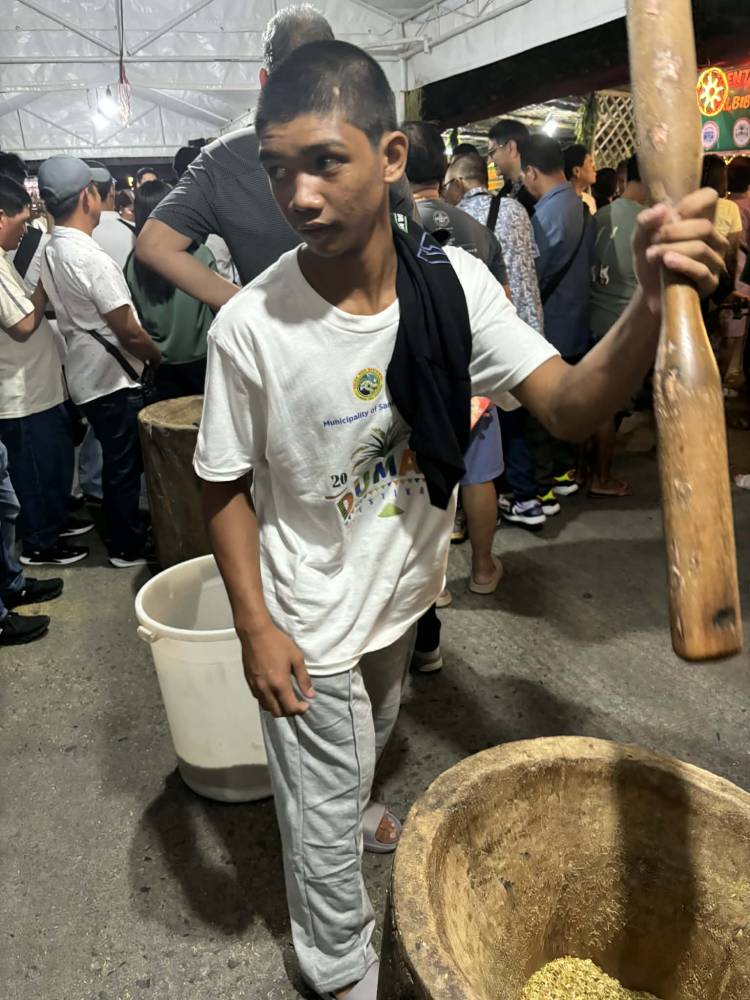
SANTA RITA, PAMPANGA—Prince Rizen “Moymoy” Valencia, 16, stood out at the town’s 23rd Duman Festival on Dec. 6 as the youngest among a dozen men pounding toasted rice in synchronized beats.
His father, Resty, brought him along in his seven-man team so he could earn P750 to P1,000 for the 15-hour laborious process of making “duman,” a native rice cereal sweetened by the “amihan” (northeasterly wind).
While locals proudly call it the “green gold,” the delicacy—and the tradition of “Pamagduman”—is facing the threat of extinction.
Only a few families still plant the glutinous rice variety, and even fewer laborers harvest it every November and produce this unique artisanal food, said Ruston Banal, a visual ethnographer and culinary historian who initiated the United Nations Educational, Scientific and Cultural Organization (Unesco) bid to safeguard Pamagduman as an Intangible Cultural Heritage.
“The Pamagduman tradition currently has a Unesco bid managed by the National Commission for Culture and the Arts (NCCA) and the Unesco National Commission of the Philippines, which was submitted in 2024,” Banal told the Inquirer.
Special lessons
The initiative was mandated by former Gov. Dennis Pineda and is facilitated through the Pampanga Arts, Culture, and Tourism Office. Banal said duman, as a tangible product, was being submitted separately for Unesco’s Geographical Indication.
Apprenticeships, such as that of young Valencia, are central to preserving the craft, similar to the way giant lantern makers in San Fernando and clay pot and coffin makers in Santo Tomas pass on their expertise. The teener seems to understand the responsibility. “Ba kung mabiasa mu rin pu (So that I can learn duman-making too),” he said during a pause.
Efforts to involve young residents of Santa Rita in preserving duman and Pamagduman are under way.
Mayor Reynan Calo announced that schools will integrate lessons about the local delicacy and tradition into Mapeh (Music, Arts, Physical Education, and Health) classes.
Principals may use Banal’s documentary, “Pamagduman: The Making of the Green Gold,” as a teaching resource. Calo instructed public school division head Emily Maninang to include these lessons in the next school year.
Since the cultural group ArtiSta Rita launched the Duman Festival in 2002, efforts to sustain the tradition have expanded.
With funding from former Mayor Yolanda Miranda-Pineda, research on the product and practice was completed in 2023.
Scientists from the Philippine Rice Research Institute purified the duman seeds into four variants, now in their second year of observation in a greenhouse.
Women’s role
They may be transplanted next year to produce the original seeds. Separate advocacy efforts by Bernard Dizon and Alvin Cuenco have increased farmers planting the glutinous rice variety from four to 24, with expectations to double in the coming years, according to Pampanga Rep. Gloria Macapagal-Arroyo.
Duman-making has long been a family enterprise, with women playing crucial roles.
In Barangay Santa Monica, the Cuenco family passed the craft from grandmother Maria Cunanan-Pineda to her daughter Julia and then to Julia’s son Alvin, who maintains the work area. Julia, who died at 89, turned to duman-making to supplement her husband Oswaldo’s farm income.
The “pati”—a wooden box used as a unit of measurement—has historically been valuable for paying taxes or selling the product.
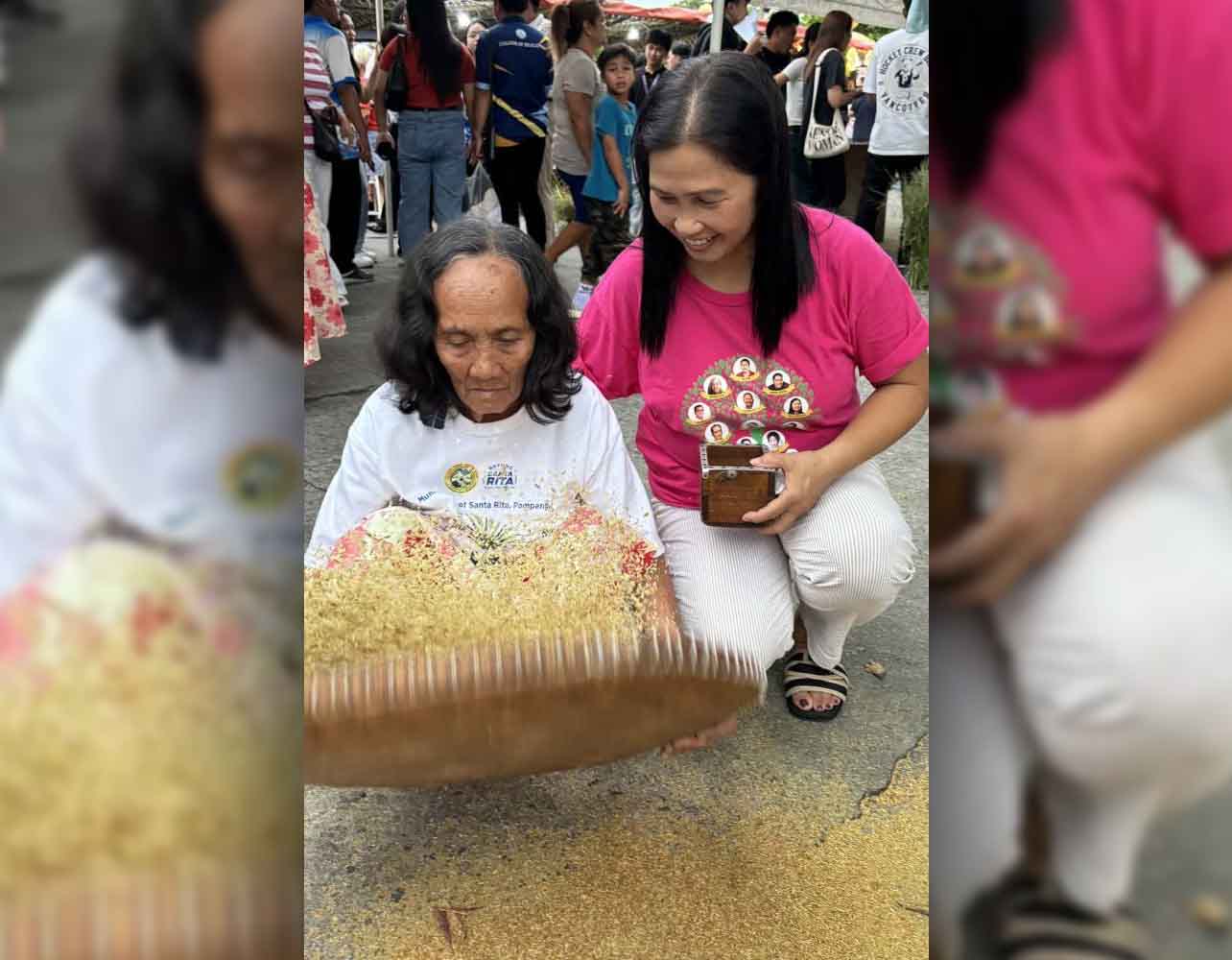
Women continue to lead key tasks like “tahip,” the laborious sieving and winnowing of toasted rice, a process performed multiple times by experts, such as Apung Senyang David, who started at age 21 and is now 82.
The festival has returned to the Santa Rita de Cascia church grounds in preparation for the parish’s 300th anniversary in 2026. “Duman-making will not die in Pampanga, especially in Santa Rita,” said Calo. “We are exerting all efforts to sustain it and make it our town’s strongest tourism platform.”—TONETTE OREJAS